
French 20 Francs Gold Coins: Napoleon, Rooster & History Guide
The French 20 francs gold coin — struck from 1802 to 1914 — is one of the most widely traded historic gold coins in the world. According to the source, every 20 francs carries 6.4516 grams of .900 fine gold in a 21 mm planchet, and its designs trace the full arc of 19th-century France: Napoleon Bonaparte, restored kings, a Second Empire, and the Marianne Rooster that became a symbol of the Republic itself.
Specifications below are sourced from Numista (catalogue entries including N#8249 and related 20 francs types). Historical details reflect the source’s catalogue data. This article is educational; it is not investment advice.
Weight and Metal Content
| Coin | Stated Metal + Weight | Mintage | Packaging |
|---|---|---|---|
| French Gold 20 Francs (all types) | Gold (.900 fine), 6.4516 g total weight | Varies by year, type, and mint | Individual coin; often traded in tubes or rolls of 10 |
| French Gold 10 Francs | Gold (.900 fine), 3.2258 g total weight | Varies by year, type, and mint | Individual coin |
A Coin Born from the Franc Germinal

According to the source, the 20 francs gold coin was created by the law of 28 March 1803 (7 Germinal Year XI), which established the franc germinal — France’s gold standard. The new coin weighed 6.4516 grams at .900 fineness, giving it a pure gold content of approximately 5.806 grams.
The source notes that the first issues carried the portrait of Napoleon Bonaparte as First Consul, engraved by Jean-Pierre Droz. When Napoleon crowned himself Emperor in 1804, the portrait changed to the laureate head of “NAPOLEON EMPEREUR” — and the 20 francs became the workhorse of French commerce for the next century.
The Major Types
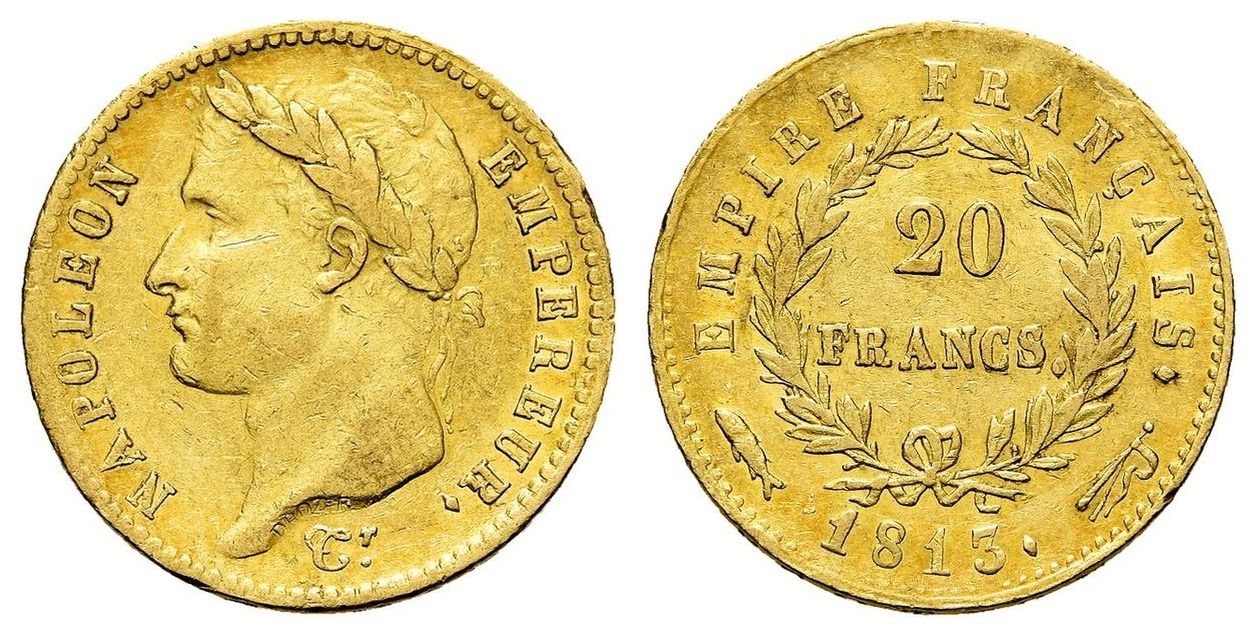
According to the source, the 20 francs kept its weight and fineness through every regime change, but the designs changed with each government:
- Napoleon I (1802–1814) — Droz’s laureate portrait with “EMPIRE FRANCAIS” wreath reverse; struck at Paris and branch mints including Utrecht, Genoa, Rome, and Turin
- Louis XVIII (1814–1824) — restored Bourbon portrait, both bare and laureate busts
- Charles X (1825–1830) — Bourbon portrait; shorter reign, lower mintages
- Louis Philippe I (1830–1848) — uncrowned portrait, “ROI DES FRANCAIS” legend
- Napoleon III (1852–1870) — laureate portrait of Louis-Napoleon; the most common 19th-century type in high grades due to massive Second Empire mintages
- Lucky Angel / Génie (1871–1898) — Augustin Dupré’s winged genius inscribing a tablet, a design dating to 1793 that the Third Republic revived
- Rooster / Marianne (1899–1914) — Jules-Clément Chaplain’s Marianne obverse with the strutting rooster reverse, “LIBERTE EGALITE FRATERNITE” legend
The Rooster: France’s Most Famous Gold Coin
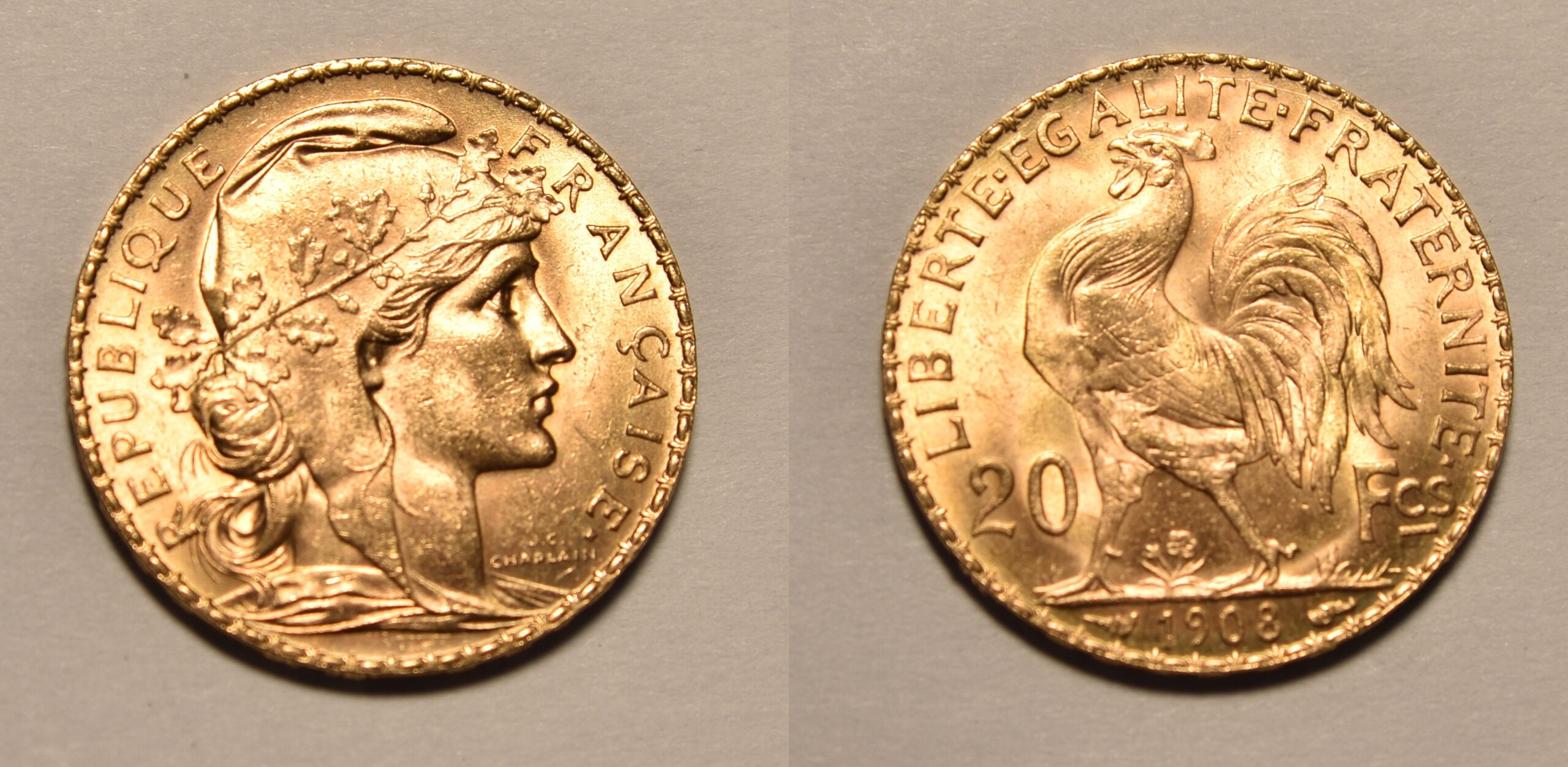
According to the source, the Rooster type — designed by Jules-Clément Chaplain — is the most recognized French gold coin worldwide. Marianne, the personification of the French Republic, appears on the obverse wearing a Phrygian cap, while the reverse shows the Gallic rooster striding before a sunrise, with “20 FCS” and the date below.
The source notes that Roosters were struck from 1899 to 1914 and were restruck in large quantities after World War I, which is why they remain the most affordable entry point into historic European gold. Restrikes carry original dates but were produced later — a detail collectors should understand when evaluating premiums.
Mint Marks and the Edge Inscription
According to the source, French 20 francs coins carry a mint mark letter identifying where they were struck. The principal mint was Paris (A), but Napoleon-era coins were struck across the Empire — the source lists mints including Genoa, La Rochelle, Bordeaux, Bayonne, Toulouse, Perpignan, Rome, Turin, Lille, and the Royal Dutch Mint at Utrecht.
The source notes a distinctive security feature: the edge of the 20 francs is inscribed in hollow letters with the motto DIEU PROTEGE LA FRANCE (“God protects France”). A genuine coin should show this inscription evenly spaced around the full edge — missing or uneven edge lettering is a key counterfeit indicator.
What the Designs Show
According to the source, each major type carries the iconography of its era. Napoleon’s laureate portrait follows the Roman imperial tradition, signaling his claim to a new empire. The Lucky Angel reverse — a winged genius writing the Constitution of 1793 on a tablet — survived from the Revolution to the Third Republic. The Rooster’s “LIBERTE EGALITE FRATERNITE” legend states the Republic’s motto outright.
The source describes the obverse legends as naming the issuing authority of the moment: “NAPOLEON EMPEREUR,” “LOUIS XVIII ROI DE FRANCE,” “NAPOLEON III EMPEREUR,” or “REPUBLIQUE FRANCAISE” — making the 20 francs series a portrait gallery of 19th-century French history.
What Buyers Should Verify
- Weight and diameter: a genuine 20 francs weighs 6.4516 g and measures 21 mm — significant deviation suggests a counterfeit or a different denomination
- Edge inscription: check for the DIEU PROTEGE LA FRANCE edge lettering, evenly spaced — fakes often have plain or reeded edges
- Non-magnetic: gold is not magnetic; a 20 francs that sticks to a magnet is not genuine
- Type and date match: confirm the portrait matches the date (e.g., no Napoleon III portrait on an 1898-dated coin — that year should be the Lucky Angel type)
- Mint mark: verify the mint letter is consistent with the type and date claimed
- Restrike awareness: many Rooster dates were restruck after WWI; restrikes are genuine gold but carry less numismatic premium than original strikes
Bottom Line
According to the source, the French 20 francs gold coin combines a standardized gold content — 6.4516 grams at .900 fine, unchanged from 1802 to 1914 — with designs that document a century of French history. From Napoleon’s Empire to the Rooster of the Third Republic, every type carries the same gold, making the series one of the most liquid historic gold coins in the world.
Frequently Asked Questions
How much gold is in a French 20 francs coin?
According to the source, the 20 francs weighs 6.4516 grams at .900 fineness, giving approximately 5.806 grams of pure gold content.
What is the “Rooster” 20 francs?
According to the source, the Rooster type (1899–1914) was designed by Jules-Clément Chaplain, showing Marianne on the obverse and a strutting rooster on the reverse with the legend “LIBERTE EGALITE FRATERNITE.”
What does the edge inscription say?
According to the source, the edge is inscribed DIEU PROTEGE LA FRANCE (“God protects France”) in hollow letters — a security feature present on genuine coins.
Were Rooster 20 francs restruck?
According to the source, many Rooster dates were restruck after World War I. Restrikes are genuine gold at the standard weight and fineness but typically carry lower numismatic premiums than original strikes.
What is the “Lucky Angel” 20 francs?
According to the source, the Lucky Angel (Génie) type shows Augustin Dupré’s winged genius inscribing a tablet. The design dates to 1793 and was revived by the Third Republic for 20 francs struck from 1871 to 1898.
Related Products
We carry French 20 francs gold spanning three classic types:
This article is for educational purposes. Specifications sourced from Numista. Images: Wikimedia Commons — Napoleon portraits public domain; 1813 Utrecht photo CC BY-SA 4.0; 1908 Rooster photo CC0 public domain. Rooster design by Jules-Clément Chaplain; Lucky Angel design by Augustin Dupré; Napoleon portraits by Jean-Pierre Droz.