
What Does a Details Grade Mean on a Coin?
Agate Precious Metals · Coin education
What Does a Details Grade Mean on a Coin?
A coin Details grade identifies a problem, such as improper cleaning, scratches, damage or corrosion, that prevents an ordinary numeric grade under the grading service’s rules. The coin may still be genuine and collectible. Read the complete label: a wear category such as AU Details is not equivalent to a straight AU numeric grade.
This guide explains common problem designations, how to compare Details coins and what to check before buying, selling or considering another submission.
Prepared October 8, 2026. Source-review dates are retained from the supplied draft. This guide does not appraise an individual coin.
Key Takeaways
- A Details designation does not mean a coin is worthless.
- The exact problem matters: cleaned, scratched, repaired and environmentally damaged describe different concerns.
- A Details label may include a wear or sharpness category without assigning a straight numeric grade.
- Compare similar problem coins rather than automatically using prices for undamaged examples.
- Verify the certification record and inspect the actual surfaces before paying.
Why Does a Grading Service Use a Details Grade?
A numeric grade communicates condition within a grading system. When surfaces have been altered or impaired, a grading service may describe the coin’s remaining detail while also identifying the problem that prevents a straight grade.
For example, an AU Details description communicates an assessment of wear or remaining detail together with a problem designation. It should not be advertised as though it were an ordinary AU50, AU55 or AU58 coin.
The label does not establish rarity, a fixed discount or a current market price. It identifies an issue that must be considered when evaluating the coin.
Common Details Descriptions
Improperly Cleaned
Cleaning can alter a coin’s original surfaces. Abrasive wiping or polishing may leave hairlines, unnatural brightness or disturbed luster. A coin can look attractive to an inexperienced viewer while still showing evidence of improper cleaning.
Do not assume every bright coin is cleaned or that every toned coin is original. Examine the actual surfaces and the service’s specific description.
Scratched or Damaged
Significant scratches, gouges, dents or rim damage may prevent a straight grade. The severity, location and visibility of the damage influence collector appeal.
Ordinary contact marks can occur on straight-graded coins. A problem designation involves the grading service’s assessment of the particular impairment, not merely the presence of any mark.
Environmental Damage
Corrosion or other environmental effects can impair surfaces. Copper-based coins can be especially vulnerable, but storage conditions can affect other metals as well.
Toning alone does not automatically establish environmental damage. Read the label and inspect the extent of the actual problem.
Repaired or Altered Surfaces
Repairs, smoothing or other alterations may attempt to conceal damage or change a coin’s appearance. These descriptions require careful inspection and honest disclosure.
Terminology varies by grading service. Use the exact label wording and the service’s own explanation rather than substituting a more favorable description.
Does a Details Grade Mean the Coin Is Counterfeit?
No. Authenticity and condition are separate questions. A genuine coin can have a surface problem that prevents a straight numeric grade.
However, a holder’s appearance alone is not proof of authenticity. Verify the certification number through the grading company’s official website and compare the returned record with the holder, label and coin. Copied certification numbers and counterfeit holders remain reasons to check the full evidence.
Use PCGS Cert Verification or NGC Verify Certification for the corresponding service.
A catalogue entry describes a coin type, not the authenticity or condition of an individual specimen. For example, the Mercury dime’s standard specifications help identify the series, but they do not authenticate a particular coin or establish its grade.
How Should You Compare a Details Coin?
Start with the exact date, mintmark, variety, grading service, wear category and problem description. Then examine photographs and relevant transaction evidence for similar examples.
| Comparison Question | Why It Matters |
|---|---|
| Does the official record match? | The holder, label and coin should correspond to the certification record. |
| What exact problem is listed? | Cleaning, damage and repair are not interchangeable descriptions. |
| How extensive is the impairment? | A conspicuous problem can affect appeal differently from a less visible one. |
| Is the exact issue scarce? | Scarcity and demand can change the relevant comparison set. |
| What type of price evidence is being used? | An asking price, completed sale and dealer bid measure different things. |
| What are the transaction costs? | Shipping, buyer fees and selling expenses affect the final amount paid or received. |
There is no universal percentage discount for a Details grade. Two coins with the same broad designation can have very different appearance, desirability and market evidence.
Form 5: The Details-Grade Review
- Identify: Confirm the exact coin, date, mintmark, variety and grading service.
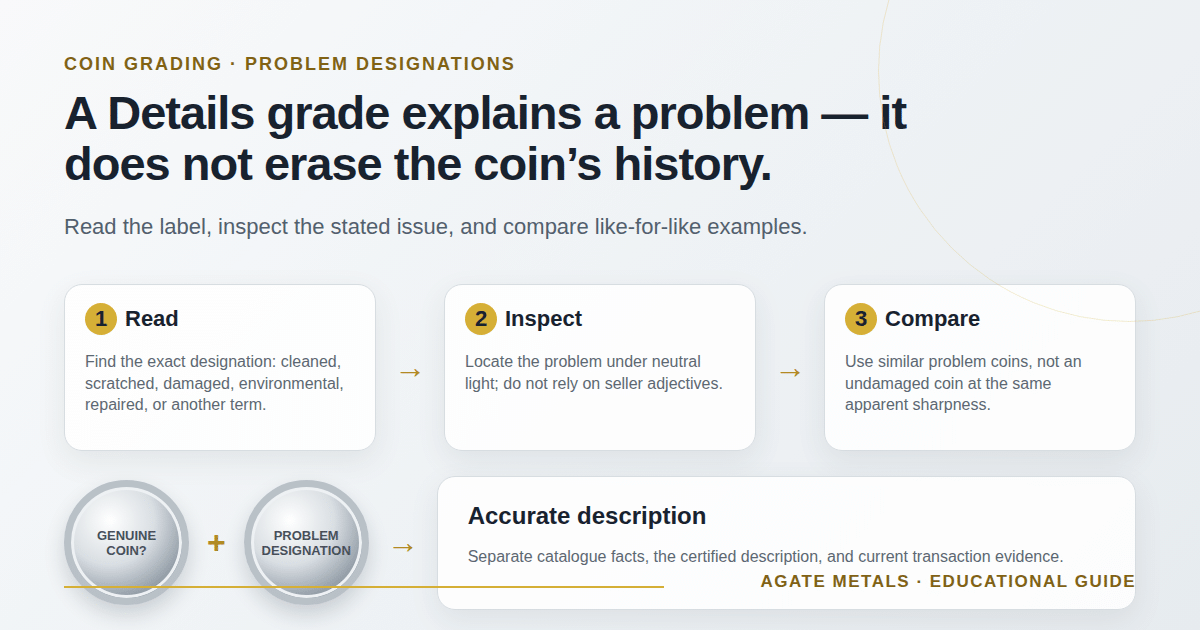
- Inspect: Locate the described problem under neutral light; do not rely only on seller adjectives.
- Verify: Check the certification record and exact label wording on the official service website.
- Compare: Use similar Details examples and distinguish asking prices from completed sales or dealer bids.
- Record: Save photographs, the problem description, source dates and written transaction terms.
This process supports a more informed comparison. It does not predict a future grade or price.
Is a Details Coin Worth Buying?
It can be, depending on the coin, problem, price and collecting goal. Some collectors accept a problem coin as an affordable example of a scarce issue. Others prioritize original surfaces or collection rules that a Details coin may not satisfy.
| Collecting Goal | Consideration |
|---|---|
| Own an example of a scarce date | A disclosed problem coin may fit the goal if its authenticity and price are supported. |
| Build a straight-graded set | A Details coin may not meet the collection’s requirements. |
| Prioritize original surfaces | Inspect the stated problem carefully; cleaning or repair may conflict with the goal. |
| Plan for future resale | Research comparable sales and likely buyer interest without assuming easy resale. |
Buy the documented coin as it is. Do not base the purchase on a seller’s unsupported promise that the designation will disappear on resubmission.
What Should a Seller Disclose?
State the grading service, certification number when applicable, full label wording and visible problems. Provide clear photographs of the holder and both coin faces, together with material transaction terms.
Avoid descriptions such as “just as good as MS” or “guaranteed to upgrade.” If the label says Uncirculated Details, include the Details designation and problem; do not shorten it to an ordinary Mint State claim.
Keep these three kinds of evidence separate:
- Type facts: The series, specifications and issue information.
- Certified description: What the grading service records for the specific coin.
- Transaction evidence: Current asking prices, completed sales or written dealer bids.
For general terminology, read Agate’s coin grading scale guide.
Frequently Asked Questions
What does a Details grade mean on a coin?
It identifies a problem that prevents an ordinary numeric grade under the service’s rules. The label may also describe remaining detail or wear. Read both the condition category and the specific problem.
Is a cleaned coin always worthless?
No. It may retain collector, historical or metal value. Cleaning can reduce appeal and marketability, but the effect depends on the exact issue and severity.
Does AU Details mean the same as AU58?
No. AU Details includes a problem designation and is not a straight AU58 grade. Do not use an undamaged AU58 price as an automatic value for an AU Details coin.
Can a Details coin be submitted again?
A grading company may accept another submission under its current procedures. A different outcome is not guaranteed, and additional fees and shipping risks apply. Evaluate the existing designation as the current documented description.
Can I fix the problem by cleaning or polishing the coin?
Do not attempt that. Cleaning, polishing and other alterations can further damage surfaces. Ask a qualified professional whether any appropriate conservation option exists; it does not guarantee removal of the designation.
How much less is a Details coin worth?
There is no fixed discount. Compare matching issues with similar problems, preservation and current market evidence. An actual dealer offer may differ from a retail asking price.
Conclusion
A Details grade is useful information when read in full. Verify the record, inspect the stated problem and compare similar examples. Describe the coin accurately and evaluate it on its documented condition rather than a hoped-for upgrade.
Sources and Research Notes
- NGC — Official grading and Details-grade resources
- PCGS — Official grading and problem-coin resources
- American Numismatic Association — Collector education
- Numista — Mercury Dime type reference
Source date recorded in the supplied draft: October 8, 2026. Grading terminology and submission procedures should be checked with the selected service. Catalogue records do not authenticate or appraise an individual coin.