
Coin Grading Scale Explained: Sheldon Grades, MS, and Proof
Coin Grading Scale Explained: Sheldon Grades, MS, and Proof
The traditional coin grading scale runs from 1 to 70, with higher numbers describing better condition within the grading system. Mint State grades run from MS60 through MS70. Proof describes a production method, not a separate guarantee of value. Read the grade together with the date, type, surfaces, and certification details.
How the Sheldon scale works
The 1–70 scale is a shared language for describing preservation. It is not a percentage score: an MS70 coin is not worth a fixed multiple of an MS65 coin, and five grade points do not represent a predictable dollar increase. The price difference depends on the issue and the market for that condition.
The NGC grading scale distinguishes circulated grades, Mint State grades, and proof or specimen production. It also explains why certain surface problems lead to a Details assessment instead of a numerical grade.
| Label family | What it communicates | What to check next |
|---|---|---|
| G / VG / F / VF | Progressively greater surviving detail on circulated coins | Wear on that particular design |
| XF / EF | Extremely Fine condition | High points and original surfaces |
| AU | About Uncirculated; limited wear | Whether apparent flatness is wear or strike weakness |
| MS60–MS70 | Mint State; no circulation wear | Marks, strike, luster, and eye appeal |
| PF / PR | Proof production | Numerical condition and finish designations |
| Details | A condition assessment with a noted problem | The exact problem and comparable problem-coin sales |
Why an uncirculated coin can still have marks
A coin can avoid circulation and still acquire contact marks during production, transport, or storage. That is why Mint State covers a range. “Never spent” and “flawless” are different ideas. Inspect the fields, raised design, rim, and edge rather than assuming an uncirculated label means an untouched surface.
For a beginner, compare several examples of the same series. Learning where that design first shows wear is more useful than trying to apply a generic photograph to every coin. Lighting also matters: an image that hides hairlines can make a coin look cleaner than it is.
Proof is not the next step above Mint State
Proof coins are made using a special process intended for collectors. They receive condition assessments too. A proof can be damaged, cleaned, or worn; a business-strike coin can have attractive reflective surfaces without becoming a proof.
Read all the identifying words on a listing. Finish, grade, date, mint mark, and a release designation answer different questions. A special label should not replace research into the underlying coin. For a valuable purchase, ask whether the image shows the actual holder or a representative example.
How to compare two graded coins
Write down the series, date, mint mark, grading company, grade, and any relevant designation. Then compare completed sales with those same characteristics. Check whether the reported amount includes an auction buyer’s premium. A dealer’s asking price and an auction’s realized price are different types of evidence.
Do not treat a Details coin as an inexpensive version of the same numerical grade. Cleaning, scratches, repairs, and environmental damage can affect demand differently. Read the problem description and inspect photographs before deciding whether the trade-off suits your collection.
Read a real product label
This example combines the year, coin series, grading company, and grade. It is a reference for reading a listing, not a recommendation to begin at the highest grade.
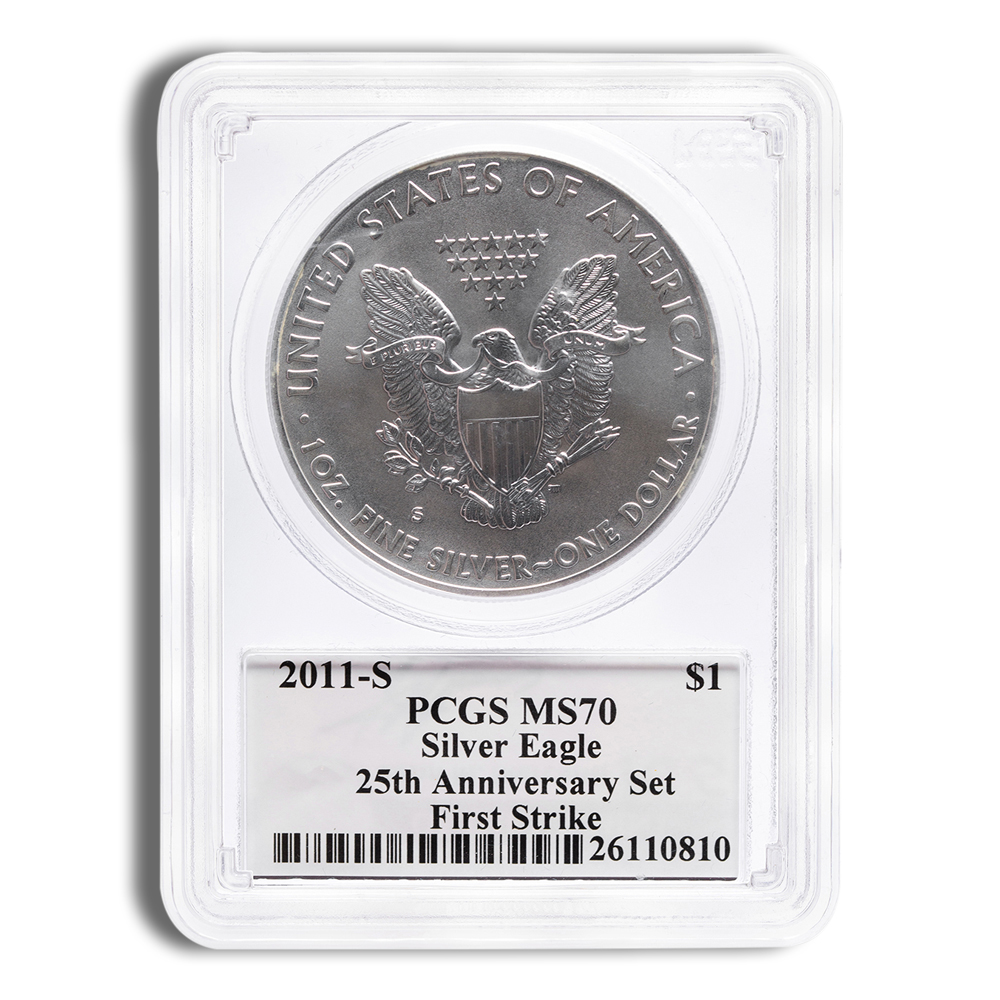
2011 Silver Eagle PCGS MS70
2011 Silver Eagle identified as PCGS MS70. Compare the complete issue and certification before comparing prices.
Prepared September 18, 2026. Product prices, premiums, availability, and transaction terms change. Examples are educational, not offers or predictions.
Verify the holder and keep the records
Check the certification number with the grading service and compare available images and label details. A valid number alone cannot prove that every holder displaying it is genuine. If the physical coin or holder does not agree with the record, stop and ask for qualified review.
Retain the purchase invoice and photographs. Do not open a certified holder just to inspect the coin more closely: you would lose the intact holder association you paid for. If you are considering submitting a raw coin, compare submission, shipping, and insurance costs with a realistic benefit first.
Continue with Agate’s silver-format comparison, the dealer-selection guide, and the precious-metals education hub.
Frequently asked questions
What is the highest traditional coin grade?
70 is the top of the traditional 1–70 scale. The service’s definition and the coin’s production category still matter.
Is MS60 circulated?
Mint State grades indicate no circulation wear, although a low Mint State grade may include many marks or other shortcomings.
Are proofs always worth more?
No. Production method alone does not determine value. Compare the exact issue, condition, demand, and sale evidence.
Does Details mean counterfeit?
Not necessarily. It commonly indicates a surface problem that prevents a normal numerical grade. Read the full assessment.
Should I grade every coin?
No. Grading costs can exceed the benefit for common or low-value pieces. Decide based on the actual coin and your purpose.