
Coin Grading Costs: Fees and Is It Worth It?
Agate Precious Metals · Coin education
How Much Does It Cost to Get a Coin Graded? A Practical Cost-Benefit Guide
Coin grading costs include more than the published service fee. Budget for any membership, handling, shipping, insurance and optional services. Certification may be worthwhile when authentication, attribution, protection or improved marketability justifies the total expense. It does not guarantee a higher value, profitable sale or particular grade.
This guide explains how to build a submission budget, compare possible outcomes and decide whether professional grading serves your collecting or selling goal.
Prepared October 8, 2026. This article explains cost categories; it does not quote current grading-company fees.
Key Takeaways
- Compare the complete submission cost, not just the advertised grading fee.
- A professional grade does not guarantee a profit or a higher dealer offer.
- Common coins with modest market value may not justify certification financially.
- High-value, uncertain, scarce or frequently counterfeited coins may justify professional review.
- Check the selected service’s current fees, eligibility and shipping instructions before submitting.
What Is Included in Coin Grading Cost?
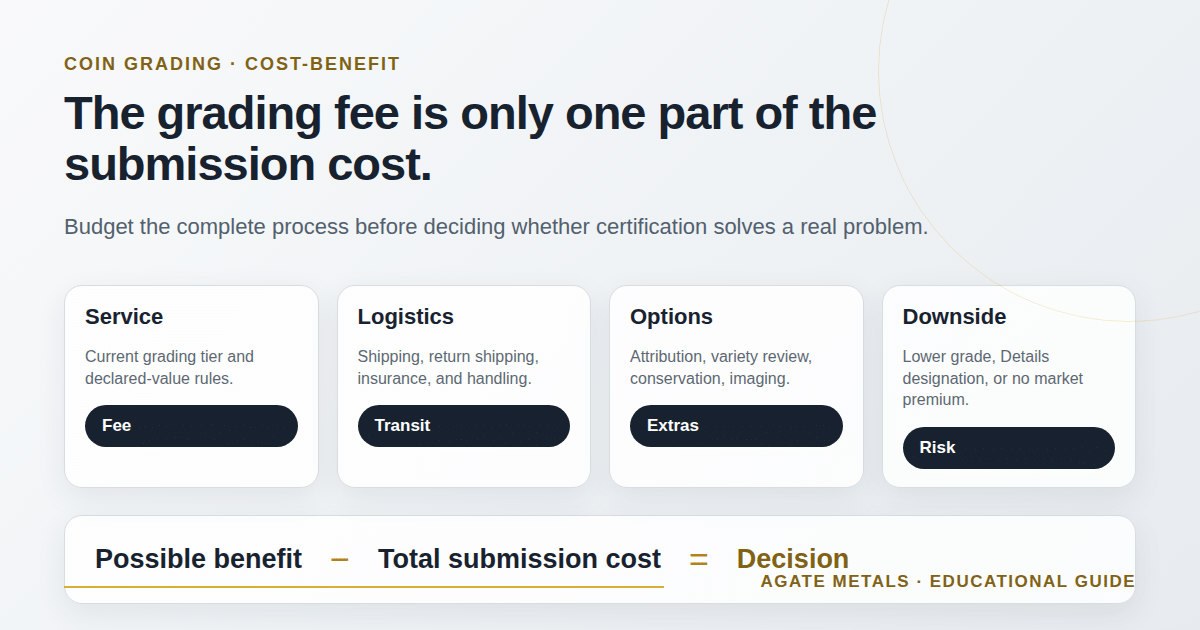
The grading company’s service tier is only one part of a submission budget. Other charges can include membership, handling, shipping to the service, return shipping, insurance, variety attribution, conservation, imaging and applicable taxes.
Declared value, coin type, service level, submission size and optional requests can affect the total. Not every category applies to every submission.
Check the current schedule directly with PCGS or NGC. Confirm what the quoted fee includes and which charges are additional.
A Simple Formula for the Grading Decision
Estimated incremental benefit of certification − total submission cost = possible economic benefit.
For a financial comparison, estimate the difference between credible net-sale outcomes for the coin raw and certified. Do not subtract grading costs from the entire certified value and call the remainder a grading profit: the coin already had value before submission.
Benefits can also be nonfinancial, such as a clearer identity, documented attribution, holder protection or easier collection management. Evaluate those separately rather than assigning them an unsupported dollar amount.
For a hypothetical $20 common coin, a full submission may be difficult to justify financially. For a coin where authenticity or a significant grade-dependent value difference matters, the same process may be more reasonable. There is no universal threshold that fits every coin.
When Professional Grading Is Worth Considering
Consider a closer review when:
- The coin may be scarce, counterfeit-prone or difficult to identify.
- The exact issue has a meaningful market difference between grades.
- A buyer, auction venue or collection policy requires certification.
- A recognized variety or attribution needs professional examination.
- A certified description would reduce uncertainty in a transaction.
- The coin’s potential value makes submission costs proportionate to the purpose.
These factors support considering a submission; they do not guarantee that grading is economical. Confirm service eligibility and current terms first.
When Grading May Not Be Worth the Cost
Certification may be less useful financially when the complete submission expense is a substantial share of a common coin’s likely value. It may also be unnecessary when the goal is simply to organize a personal collection or sell ordinary material primarily for its metal content.
A common coin can still have historical, educational or sentimental value. Separate those reasons for ownership from the question of whether paid certification is likely to improve a sale.
Example: A Lincoln Wheat Cent
Lincoln Wheat cents were issued from 1909 through 1958. Most use a copper-based composition and a standard weight of 3.11 grams, while ordinary 1943 issues use zinc-coated steel. The date and composition must be identified before applying a type-level reference.
Before submitting a common-series coin, confirm its exact date and mintmark, check for a recognized variety, inspect its surfaces and compare relevant market evidence.
A catalogue photograph cannot grade your coin. A series reference also cannot establish the value of a particular example.
How Condition Changes the Economics
The decision becomes more sensitive when the coin is near a grade-dependent market breakpoint. A small difference in preservation may matter substantially for one issue and very little for another.
Cleaning, damage, environmental problems or an incorrectly identified variety can undermine the expected result. Even a desirable numeric grade may not produce the premium you anticipated.
Avoid reasoning that a high-grade example sold for a large amount, so your coin will receive that grade and price. Compare several plausible outcomes and distinguish asking prices, completed sales, catalogue estimates and dealer bids.
Form 5: The Five-Question Grading Budget
- Identify: What exact date, mintmark, variety, denomination and composition does the coin have?
- Inspect: Are there signs of cleaning, scratches, corrosion, damage or altered surfaces?
- Verify: Is authentication, attribution or a certified holder needed for your purpose?
- Compare: What is the complete submission cost relative to credible market evidence?
- Record: Write down your assumptions, sources and maximum acceptable expense.
This is a decision aid, not a prediction of the grade or sale price.
What Costs Should Be Included in the Worksheet?
| Cost Category | Questions to Ask |
|---|---|
| Service tier | What does the current fee include, and what declared-value limit applies? |
| Membership or submission access | Can you submit directly, and does your chosen route involve membership or dealer charges? |
| Shipping | What will it cost to send and receive the coin using the required procedures? |
| Insurance | What coverage applies in transit and while the service holds the coin? |
| Handling | Are charges assessed per submission, invoice or item? |
| Optional services | Are attribution, conservation, imaging or other requests necessary? |
| Time | Could turnaround affect a planned sale or collection deadline? |
| Downside outcome | Would the submission still serve its purpose with a Details designation or lower grade? |
When submitting multiple coins, allocate shared charges sensibly. A per-coin average can help compare costs, but each coin still needs its own submission rationale.
Which Decision Fits Your Situation?
| Situation | Useful Next Step |
|---|---|
| Common, low-value coin | Compare the full expense with realistic raw and certified outcomes before submitting. |
| Potentially scarce date or variety | Confirm identification and investigate an appropriate attribution service. |
| Authenticity concern | Seek qualified examination; authentication may matter independently of resale profit. |
| Sentimental collection piece | Evaluate protection and documentation benefits separately from financial return. |
| Existing certified coin | Verify the current record before considering reholdering, crossover or regrading costs. |
Is a Details Grade a Failed Submission?
Not necessarily. A Details designation can communicate that a genuine coin has cleaning, damage or another problem that prevents an ordinary numeric grade under the service’s rules.
The coin may remain collectible, but comparisons must account for the stated problem. Do not value a Details coin as though it were an undamaged numeric-grade example.
Agate’s coin grading scale guide explains general grading terminology.
Frequently Asked Questions
How much does it cost to get a coin graded?
The total depends on the grading service, tier, declared value, submission route, shipping, insurance and optional services. Check the current fee schedule and calculate the complete expense rather than relying on one advertised fee.
Is coin grading free?
Professional grading is generally a paid service. A membership credit, promotion or package may cover particular charges, but check its terms and any remaining shipping, handling or optional fees.
Should I grade every old coin?
No. Age alone does not make certification economical. Identify the exact issue, assess condition conservatively and compare the full cost with the purpose of submission.
Can a dealer tell me whether grading is worthwhile?
A knowledgeable dealer can provide a market perspective. Ask what evidence supports the recommendation and whether the dealer has a financial interest in the submission or transaction.
Does a higher grade guarantee a higher price?
No. The issue, demand, eye appeal, designation, grading service and selling venue also matter. A grade is a description, not a guaranteed sale price.
Should I clean a coin before submitting it?
No. Cleaning can alter surfaces and affect grading. Preserve the coin as found and ask the selected service about appropriate professional conservation if needed.
Conclusion
Ask what certification will accomplish, what the complete process costs and whether the exact coin’s evidence supports the expense. Include lower-than-expected grades and problem designations in your comparison, then verify the service’s current terms before submitting.
Sources and Research Notes
- PCGS — Official grading and submission resources
- NGC — Official grading and submission resources
- American Numismatic Association — Collector education
- Numista — Lincoln Wheat Cent type reference
Source date recorded in the supplied draft: October 8, 2026. Confirm current fees and submission terms directly with the service. Catalogue facts do not establish an individual coin’s grade or value.