
How to Verify a PCGS or NGC Coin Certification Number
Agate Precious Metals · Coin education
How to Verify a PCGS or NGC Coin Certification Number
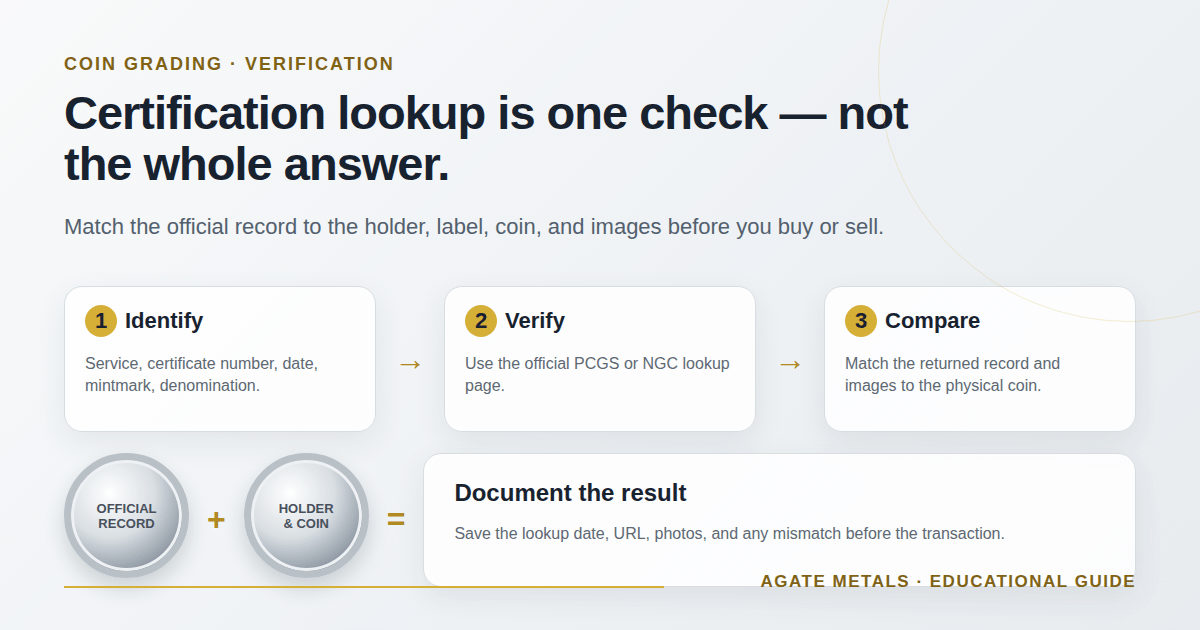
A PCGS or NGC certification lookup is a useful first check when you are considering a slabbed coin, but it is not a substitute for comparing the holder, label, coin, photos and transaction terms. Enter the certification number only on the grading company’s official verification page, then confirm that the returned denomination, date, mintmark, variety, grade and images match the coin in front of you.
Draft for editorial review · Prepared October 8, 2026. Source-review dates are retained from the supplied draft.
Key Takeaways
- Use the official PCGS Cert Verification or NGC Verify Certification page, not an unfamiliar third-party lookup form.
- Compare every returned field with the physical holder and coin; a matching number alone does not prove that the coin and holder belong together.
- Record the certificate number, grade, date, mintmark, variety and any image mismatch before buying or selling.
- Certification is an opinion from a grading service, not a guarantee of current market value, future price or a dealer’s offer.
What Does a Coin Certification Number Verify?
A certification number links a graded coin’s holder to a record in a grading company’s database. Depending on the service and record, the lookup may show the coin’s date, mintmark, denomination, grade, variety or attribution, and images. PCGS presents a Cert Verification tool, while NGC provides an official Verify NGC Certification route.
The lookup is best understood as an identity-and-record check. It helps answer, “Does this number correspond to a record with these basic characteristics?” It does not answer every question a buyer may have, including whether the holder has been tampered with, whether the coin has changed since imaging, whether a premium is justified, or what a dealer will pay today.
How to Verify a PCGS Certification Number
- Go directly to the official PCGS website and open Cert Verification.
- Enter the certification number exactly as printed on the holder.
- Compare the returned description with the physical coin and label.
- Check the date, mintmark, denomination, grade, variety and any listed designation.
- Compare official images with the coin when images are available.
- Save the result date and URL in your purchase or inventory notes.
Do not rely on a search result that merely displays a number. Navigate to the grading company’s domain yourself, because counterfeit holders and copied certificate pages can be designed to look convincing.
Start with official PCGS Cert Verification.
How to Verify an NGC Certification Number
Use NGC’s official Verify Certification page. Enter the requested certification information exactly as printed, then compare the returned record with the holder and coin.
Pay attention to details that can be easy to overlook: a mintmark, recognized variety, proof or cameo designation, and the coin’s photographs. If the lookup shows a different coin type or grade, stop and ask the seller to explain before proceeding.
A lookup result that cannot be found is not automatically proof of fraud. The number may have been entered incorrectly, the service may be handling an older record differently, or the lookup may be temporarily unavailable. Pause, re-enter the information from the holder and contact the grading service if necessary.
Avoid treating an unverified slab as equivalent to a verified one.
What Should Match Between the Record and the Coin?
| Check | What to Compare | Why It Matters |
|---|---|---|
| Certification number | Number on the label and official result | Confirms that the lookup begins with the correct record |
| Date and mintmark | Label, coin and database result | Separates otherwise similar issues |
| Denomination and type | Coin design and record description | Prevents a wrong-coin or wrong-label assumption |
| Grade | Label and returned record | A grade is part of the certified description, not a guarantee of value |
| Variety or designation | Label, record and coin diagnostics | May materially change how collectors compare the issue |
| Images | Holder and coin against official images | Can reveal a possible mismatch that a number alone will not |
A mismatch should be treated as a stop signal, not a negotiating opportunity. Do not assume the seller can fix the record after payment or that a lower price makes the risk acceptable.
A Morgan Dollar Example
Numista’s Morgan Dollar catalogue record identifies the historic United States type with a stated weight of 26.73 grams and composition of 90% silver and 10% copper. That catalogue information can help a reader understand the type being discussed, but it does not verify a specific Morgan Dollar, holder, certification number or purchase.
For a real transaction, compare the exact coin and holder with the grading company’s record. Do not use a catalogue photograph as proof that an Agate product or a reader’s coin is authentic.
Form 5: The Five-Minute Certification Check
- Identify: Record service, certification number, denomination, date and mintmark.
- Inspect: Look at the holder seams, label printing, coin orientation and visible surfaces.
- Verify: Run the number on the official PCGS or NGC lookup page.
- Compare: Match the database record and images to the physical coin.
- Record: Save the lookup date, URL, photos, seller description and any unresolved mismatch.
This checklist does not authenticate a raw coin or guarantee that a holder has not been altered. It creates a documented starting point for a more careful decision.
What if the Certification Lookup and Coin Do Not Match?
Do not buy, relabel or advertise the coin as matching the certification record until the discrepancy is resolved. Photograph the holder and coin, preserve the listing or invoice, and contact the grading service through its official support route.
If you already own the coin, keep the item separated from verified inventory so the mismatch is not accidentally repeated in a future sale.
If the record matches but the coin appears different from the official image, ask whether the service’s image policy or imaging system explains the difference. Physical condition, lighting, image angle and the limits of online photographs still matter.
Does Certification Determine a Coin’s Value?
No. Certification can make a coin easier to identify and compare, but current value depends on the exact issue, grade, eye appeal, population and market context, demand, price evidence, seller terms and transaction venue.
A certification lookup should never be presented as an appraisal or a promise of resale value.
For educational context, see Agate’s coin grading scale guide and U.S. coin values by type, date, grade and melt value. When a transaction is involved, compare the exact item and current written terms.
Frequently Asked Questions
Can I verify a PCGS or NGC number on a marketplace page?
Use the grading company’s official domain instead. A marketplace listing may copy a number correctly, but it is not the authoritative lookup record.
Does a matching certificate number prove a slab is genuine?
It is an important check, but not the only one. Compare the holder, label, coin and official images, and contact the service if anything is inconsistent.
What if the number returns a different coin?
Stop the transaction and document the discrepancy. Do not assume the holder, label or listing is correct until the discrepancy has been satisfactorily resolved.
Can certification verify a raw coin?
No. A raw coin has no corresponding grading-company holder to compare with a certification record. It requires a separate identification, authenticity and condition assessment.
Conclusion
Use the official PCGS or NGC page, compare the complete returned record with the physical coin, and document anything that does not match. Treat the lookup as one layer of due diligence rather than an appraisal, authenticity guarantee or investment forecast.
That approach creates better inventory records and makes future conversations with a dealer more precise.
Sources and Research Notes
- PCGS — Official Cert Verification
- NGC — Official Verify Certification
- Numista — Morgan Dollar type reference
Source date recorded in the supplied draft: October 8, 2026. Catalogue facts describe a coin type; they do not authenticate an individual specimen.