
A Walking Liberty half dollar is worth at least its silver melt value — $19.10 at today’s silver price — and most common dates sell for $20 to $35 in circulated condition. The exceptions are a short list of key dates and high grades, where the same coin brings hundreds or thousands of dollars.
This guide prices collector value: what each date, mintmark and grade actually sells for. If you only need the silver itself, our guide to the Walking Liberty half dollar’s silver content and melt value does the melt math in full — here, that $19.10 melt figure is just the floor every price below stands on. Melt figure from silver spot of $52.81/oz, Data by Bullion Price Check, data as of November 8, 2026, 7:57 PM ET. Guide prices checked November 2026.
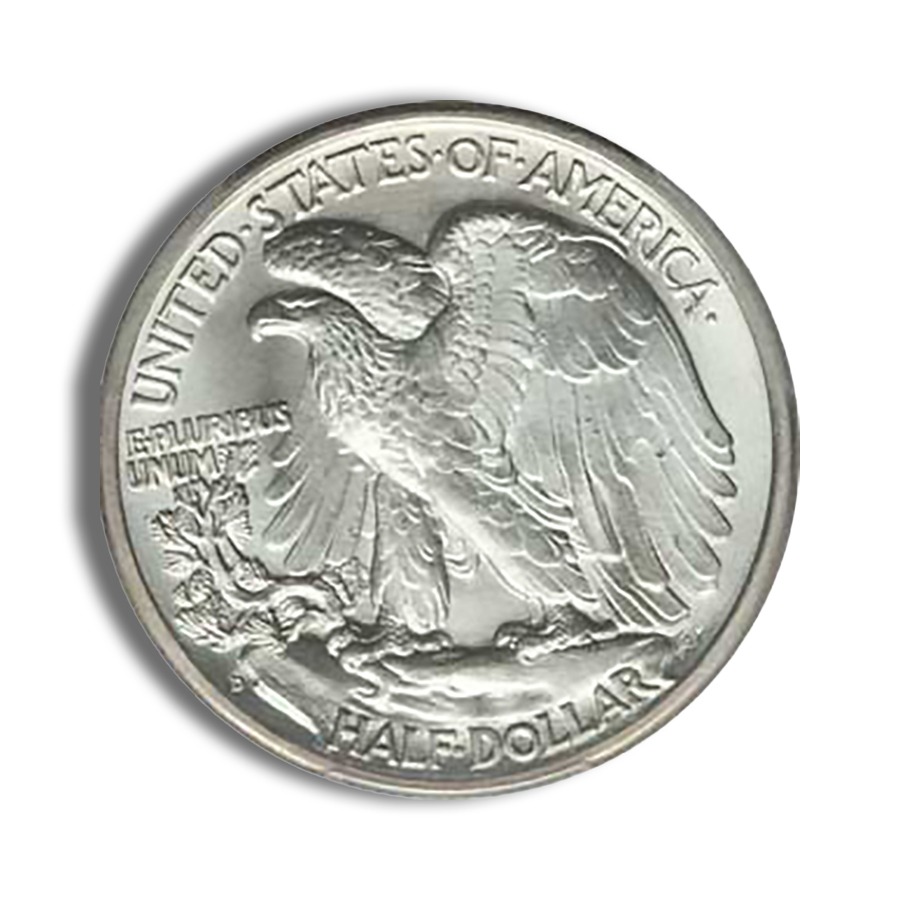
Walking Liberty Half Dollar Value by Date and Grade
Most Walking Liberty halves trade in a narrow band just above melt. The value lives in the exceptions — the low-mintage dates of 1916 and 1921, the 1938-D, and any early date in high grade. Typical retail ranges:
| Date or group | Circulated (G–VF) | XF–AU | Mint state (MS-60+) |
|---|---|---|---|
| Common dates, 1934–1947 | $20–$35 | $35–$75 | $90–$300 |
| Common early dates, 1917–1933 | $25–$60 | $75–$250 | $300–$1,500 |
| 1916-D (400,000 struck) | $95–$150 | $450–$700 | $1,600+ |
| 1916-S (508,400 struck) | $65–$110 | $300–$450 | $1,350+ |
| 1921 Philadelphia (246,000 struck) | $275–$475 | $1,000–$1,600 | $5,500+ |
| 1921-D (208,000 struck) | $375–$650 | $1,400–$2,200 | $7,500+ |
| 1921-S (548,000 struck) | $110–$275 | $1,500–$2,500 | $15,000+ |
| 1938-D (491,600 struck) | $80–$200 | $300–$450 | $750+ |
Three of these dates get a full guide of their own: the 1921-D, the rarest of the series; the 1921 Philadelphia, its mint’s rarest date; and the 1916-S, the first-year key with its mintmark on the front. The full checklist of dates worth pulling from a pile first is in the Walking Liberty key dates guide.
What Makes One Worth More Than Melt
Mintage. Value follows scarcity, and scarcity was set the year the coin was struck. The Mint made tens of millions of 1940s halves but only a few hundred thousand in 1916 and 1921 — that gap, not age alone, is why a 1921 outprices a 1916 common issue.
Grade, and the head. Walking Liberty halves are famous for weak strikes: Liberty’s head, hand and the skirt lines are often flat even on coins that never circulated. A mint-state coin with a fully struck head sells for a strong multiple of a soft one at the same numeric grade, and the premium grows with the grade.
Survival, not just mintage. The 1921-S had a mid-range mintage of 548,000, yet it is the most expensive 1921 in mint state — almost all of them circulated hard, so unworn survivors are genuinely rare. What a date is worth depends on how many remain at each grade, not only how many were made.
Condition problems erase premiums. Cleaning, polishing, scratches and rim damage can cut a key date’s value in half or worse. A problem-free circulated key beats a damaged one a grade higher, almost every time.
Proofs are their own market. Proof Walking Liberty halves were struck from 1936 to 1942 in small numbers. Even the later, more common proofs start at several hundred dollars, priced by cameo contrast and freedom from hairlines rather than by the table above.
How to Check Your Coin
Read the date at the bottom of the front, then find the mintmark. On 1916 coins and some struck in early 1917, the mintmark sits on the front, low at the left near the date; on the rest of the series it is on the back, at the lower left near the rim. No mintmark means Philadelphia. Match your date against the table above, then grade it honestly: a circulated coin shows wear on Liberty’s head, breast and skirt lines first. And do not clean it — cleaning is the fastest way to turn a collector coin into a melt coin.
Selling a Walking Liberty Half Dollar
Key dates and mint-state coins sell one at a time, and certified examples bring the strongest prices. Common dates move the other way: by silver weight, in dollar face-value lots. Our $1 face-value Walking Liberty half dollar lots show how the common-date market prices them — two coins to the dollar of face value, traded against the melt floor with a premium for condition.
Walking Liberty Half Dollar Value: Questions
How much is a 1943 Walking Liberty half dollar worth?
About $20 to $35 in circulated condition. The 1943 is a common date with a mintage in the tens of millions, so it trades on its silver: $19.10 in melt, plus a small premium that grows with condition — mint-state examples bring roughly $100 to $250.
What is the rarest Walking Liberty half dollar?
The 1921-D. Denver struck just 208,000, the lowest mintage of the series, and worn examples start around $375. See the 1921-D guide for its full grade ladder.
Are Walking Liberty half dollars worth more than melt?
Most are not worth much more — common dates trade close to their $19.10 melt value. The ones worth real premiums are the key dates in the table above, early dates in high grade, and proofs. For the melt calculation itself, see the silver content and melt value guide.
How much silver is in a Walking Liberty half dollar?
Each coin holds 0.3617 troy ounces of pure silver (90% silver, 12.5 grams total). That figure drives the melt floor used here; the full breakdown is in the melt value guide.
Which Walking Liberty dates should I check first?
Any 1921, any 1916, and the 1938-D — then early dates in unusually sharp condition. The key dates guide ranks them in checking order.