
The 1938-D is the last Walking Liberty half dollar Denver ever struck, with just 491,600 minted. A worn example is worth about $65 to $85, while the finest known sold for $44,400.
That combination — a modest price in circulated grades, a five-figure ceiling at the top — is what makes the 1938-D the series’ sleeper key date. Below: how the two 1938 issues compare, why this date is scarce in every grade, and what each grade is worth. Prices checked November 13, 2026; melt figure from silver spot of $49.94/oz, Data by Bullion Price Check, data as of November 13, 2026, 8:49 AM ET.
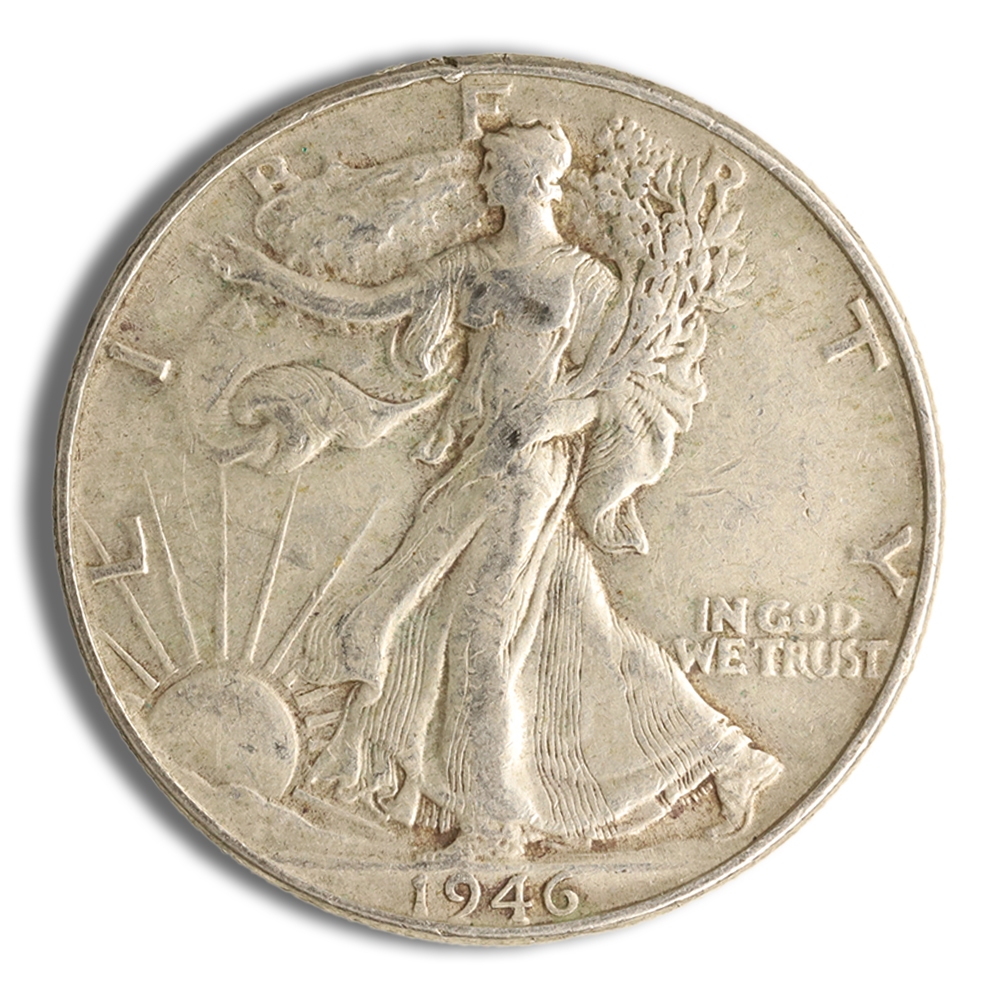
The 1938 Issues Side by Side
Two mints struck Walking Liberty halves in 1938, and the gap between them is enormous. Philadelphia made more than eight times as many coins as Denver — enough that the Philadelphia issue is a common date, while the Denver issue is the key date of the late series. A small proof run was also struck at Philadelphia for collectors.
| 1938 issue | Mintage | Typical worn value |
|---|---|---|
| 1938 (Philadelphia) | 4,118,152 | About melt |
| 1938-D (Denver) | 491,600 | $65–$85 |
| 1938 Proof (Philadelphia) | 8,152 | Collector market only |
Denver’s 491,600 pieces were roughly 11% of total 1938 half dollar production. The Philadelphia issue, by contrast, is the lowest-mintage Philadelphia Walking Liberty half of the 1934–1946 span and still trades near melt in worn condition — mintage alone does not make a coin valuable, but the Denver shortfall does.
Why the 1938-D Is a Sleeper Key
The 1938-D has the third-lowest mintage of any business-strike Walking Liberty half dollar. Only the 1921-D (208,000) and the 1921 Philadelphia (246,000) are lower. It is also the lowest-mintage late-series issue by a wide margin, and the last Denver Walking Liberty half ever made: after 1938, no half dollars were struck at any mint in 1939 or 1940, and production did not resume until 1941.
Scarcity follows the coin into every grade. Price guides describe circulated 1938-D halves as rare and mint state pieces as simply scarce — most of the small mintage went into everyday circulation and stayed there, so even worn examples are hard to find, and uncirculated ones are genuinely uncommon. It is a required date for a complete Walking Liberty set, which keeps demand steady from collectors who will never touch a 1921 key date. That steady, set-driven demand is why a coin worth about $18 in silver sells for $65 and up even heavily worn.
What a 1938-D Is Worth by Grade
The ladder below is built from the major price guides and recent auction results, stated as approximate ranges. The circulated grades move in small steps — this is a date whose value comes from scarcity, not from a single dramatic jump — and the real money starts in mint state, where a gem can reach five figures.
| Grade | About what it is worth |
|---|---|
| Good (G-4) | $65–$85 |
| Very Good (VG-8) | $85–$100 |
| Fine (F-12) | $100–$115 |
| Very Fine (VF-20) | $120–$140 |
| Extremely Fine (XF-40) | $150–$175 |
| About Uncirculated (AU-50) | $180–$230 |
| Mint State (MS-60) | $240–$400 |
| Mint State (MS-63) | $400–$600 |
| Mint State (MS-65) | $700–$1,000 |
Above the table, the record is an MS-67+ that sold for $44,400 at Heritage Auctions in September 2020. More recent results keep the top end honest: a CAC-approved MS-66 sold for $2,382 in January 2025, and PCGS MS-65 examples traded around $1,000 in October 2026. At the other end, a worn but problem-free 1938-D is worth about $65 — more than three times its silver — because there are only 491,600 of them and every complete set needs one.
How to Tell a Genuine 1938-D
Start with the date: 1938, at the bottom of the obverse under Liberty’s feet. Then turn the coin over. The D mintmark sits on the reverse just above the words HALF DOLLAR, to the right of the mountain crag — the placement used for the whole series after the mintmark moved from the obverse partway through 1917. A 1938-dated half with its mintmark on the front, or with no mintmark at all, is the common Philadelphia issue, not the Denver key date.
Two cautions. First, the added-mintmark fake: a common 1938 Philadelphia half with a D added to the reverse. On a genuine coin the D is struck into the metal with the same depth and texture as the design around it; an added mark sits on the surface and usually shows a seam or tool marks. Second, do not confuse the 1938 proof with a business strike: the 8,152 proofs were struck at Philadelphia with mirror fields and sharp, frosted devices, and they trade in a different market entirely. For any key-date Walker at a significant price, buy it certified by PCGS or NGC and run the check in our guide to verifying a PCGS or NGC certification number before you pay.
The Silver Underneath
Every Walking Liberty half dollar is 90% silver and 10% copper, weighs 12.50 grams, measures 30.6 millimeters across, and carries 0.3617 troy ounces of pure silver. At today’s silver spot of $49.94/oz that silver is worth $18.06 — the floor under any genuine 1938-D, no matter how worn. Data by Bullion Price Check, data as of November 13, 2026, 8:49 AM ET. The full melt and silver-content breakdown for the series lives on our Walking Liberty half dollar silver content and melt value page.
Shop Walking Liberty Halves
A 1938-D is a collector’s coin, not a bullion buy — but the series it belongs to is one of the best-loved silver stacks in American coinage. Our $1 FV 90% Silver Walking Liberty Half Dollar lot is $37.42 and in stock at the time of writing, and the $1 FV 90% Silver Walking Liberty Half Dollars – XF lot is $37.40. For the series as a whole, see Walking Liberty half dollar value by date and grade and the Walking Liberty half dollar key dates guide, plus the sibling key dates 1921-S, 1921-D, and 1916-S.
Frequently Asked Questions
How many 1938-D Walking Liberty half dollars were made?
491,600. Denver struck roughly 11% of all 1938 half dollars; Philadelphia made 4,118,152, plus 8,152 proofs.
What is a worn 1938-D Walking Liberty half dollar worth?
About $65 to $85 in Good condition, and about $85 to $100 in Very Good. Even heavily worn, it is worth more than three times its $18.06 in silver because every complete set needs one.
Why is the 1938-D Walking Liberty half dollar valuable?
It has the third-lowest mintage in the series — only the 1921-D and 1921 Philadelphia are lower — it is the last Denver Walking Liberty half ever struck, and no half dollars were minted in 1939 or 1940. Circulated examples are scarce and mint state pieces are scarcer still.
Is the 1938-D the rarest Walking Liberty half dollar?
No. The 1921-D and the 1921 Philadelphia are rarer by mintage, and the 1921-S is rarer in mint state. The 1938-D is the scarcest late-series date and the key date of the 1934–1947 short set.
How much silver is in a 1938-D half dollar?
0.3617 troy ounces of pure silver in a 90% silver coin — $18.06 in melt at the November 13, 2026 spot price. The coin’s collector value starts at about $65, far above melt.
Values here are typical dealer reference ranges checked November 13, 2026, not a quote or an offer to buy. An individual coin’s value depends on its grade, strike, and surfaces. Educational content only — not financial advice.