
Engelhard 10 oz Silver Bars: Authenticity, Varieties, and Collector Premiums
Engelhard 10 oz Silver Bars: Authenticity, Varieties, and Collector Premiums
An Engelhard 10 oz silver bar can be worth more than its silver melt value, but the premium depends on the exact variety, condition, serial-number format, buyer demand, and whether the bar can be authenticated. A logo and a serial number are useful starting points, not proof by themselves. Before assigning a collector premium, verify the bar’s weight, dimensions, markings, provenance, and professional test results.
-
Engelhard made multiple 10 oz bar formats, including poured or cast-looking bars and later pressed or machined examples.
-
Hallmark placement, typography, purity markings, serial prefixes, finish, and counterstamps can help identify a variety.
-
A rare-looking serial number or attractive patina does not replace weight, measurement, and professional authenticity testing.
-
Collector value and bullion value are separate. A dealer may bid primarily on silver content, while a specialist collector may pay more for a documented variety.
What makes an Engelhard 10 oz bar different from an ordinary silver bar?
A standard bullion bar is usually valued primarily by its silver content, purity, brand recognition, and current market premium. Vintage Engelhard bars may add another layer: historical interest and collector demand for particular production varieties.
That does not mean every older Engelhard bar is rare. Many bars were produced in commercial quantities, and the same broad design can appear with different serial ranges, finishes, hallmarks, or plant references. The correct question is not simply, “Is this an Engelhard?” It is, “Which Engelhard variety is this, and can the variety and condition be supported?”
A collector reference devoted to Engelhard 10 oz production describes differences in hallmark placement, weight and purity stamping, serial-number styles, and surface finish. It also separates early poured or cast-looking examples from later commercial pressed bars. That specialist information is useful for research, but it should be treated as a collector reference rather than a guarantee of rarity, value, or authenticity.[1]
First identify the physical format
Poured, cast-looking, or “loaf” bars
Older poured or cast-looking bars often have a less uniform surface, rounded edges, irregular texture, or visible marks from the production process. Those characteristics may be consistent with a genuine vintage format, but they can also be imitated. A rough finish is not an authenticity test.
Collectors may use terms such as “loaf,” “chunky,” or “poured” to describe visual formats. Because terminology varies among sellers, photograph the entire bar and record its exact dimensions instead of relying on a listing title.
Pressed, struck, or machined-finish bars
Later commercial bars may have flatter faces, more uniform edges, cleaner typography, and a pressed or machined appearance. Some can look less visually dramatic than an early poured bar while still being historically interesting or collectible.
The finish should be considered together with the bar’s lettering, logo, purity mark, serial prefix, dimensions, and weight. No single visual feature should determine the conclusion.
What should you inspect on the bar?
1. Hallmark and logo placement
Record where the Engelhard mark appears, how it is shaped, and whether the lettering matches known examples of the claimed series or variety. Pay attention to the shape of the “E,” the spacing of the company name, the surrounding border, and whether the hallmark appears on the obverse, reverse, or both.
Do not compare only with a low-resolution marketplace photo. Use multiple reference images and make sure the comparison is for the same country, production family, and approximate period.
2. Weight and dimensions
A nominal 10 troy ounce bar should be weighed with a precise scale and measured with calipers. Record the results in grams and millimeters, then compare them with a reliable reference for the specific variety.
Weight alone cannot prove authenticity. Silver bars can have manufacturing tolerances, surface wear, or accumulated residue. A counterfeit can also be made to the correct nominal weight by changing dimensions or using a different material.
3. Purity and weight markings
Look for markings such as “10 TROY OUNCES,” “FINE SILVER,” and a fineness indication. The exact typography, placement, punctuation, and depth of the stamp may matter when comparing varieties.
A mark is evidence to evaluate, not a certificate. Counterfeiters can copy logos and text. If the purchase price reflects a collector premium, the standard for verification should be higher than a casual visual match.
4. Serial number and prefix
Many Engelhard 10 oz examples are discussed by collectors through serial prefixes and number ranges. A specialist reference lists differences among P, C, Canadian, and other production or counterstamped varieties, along with example serial numbers and estimated mintages.[1]
Use the serial number to locate comparable references, not to assume that a low number is automatically rare. Check whether the prefix, font, spacing, and placement are consistent with the claimed variety. A serial number that appears reused, poorly stamped, or inconsistent with the rest of the bar deserves additional scrutiny.
5. Surface, toning, and damage
Natural toning, small marks, and handling wear may be normal for an older bar. They can affect appearance and collector preference, but they do not prove originality. Artificial toning, cleaned surfaces, solder marks, edge damage, or altered stamping can affect both authenticity and value.
Photograph the front, back, all edges, and any unusual marks under consistent lighting. Keep the original images and the seller’s description if the bar was purchased from another party.
How can an Engelhard 10 oz bar be authenticated?
Home checks can identify obvious problems, but they cannot certify a collector bar. A sensible sequence is:
-
Confirm the seller and transaction record. Keep invoices, photographs, listing screenshots, and any stated provenance.
-
Weigh and measure the bar. Use a calibrated scale and calipers where possible.
-
Compare the markings. Check the logo, typography, serial prefix, purity stamp, finish, and dimensions against more than one specialist reference.
-
Use non-destructive screening. Electrical conductivity, ultrasound, specific-gravity calculations, and X-ray fluorescence can each provide information, but each method has limitations.
-
Escalate to a qualified dealer or testing service. A professional should evaluate the bar before a substantial collector premium is paid.
-
Separate metal testing from variety attribution. A test may support the silver content without proving that the bar is a rare or original Engelhard variety.
Agate’s existing guide on what a precious-metal verifier can and cannot prove is useful background for this distinction: a device reading is evidence within a method’s limits, not an automatic authentication certificate.[2]
Bullion value versus collector premium
The bullion value is the silver content multiplied by the current silver spot price. If a bar contains 10 troy ounces of fine silver, its melt-value baseline is:
10 troy ounces × current silver spot price = approximate silver-content value
The actual dealer bid may be below that theoretical figure after the dealer’s spread, testing costs, market conditions, and the condition of the bar. A collector’s asking price may be much higher than both melt value and a dealer’s ordinary bullion bid.
A collector premium is more defensible when the exact variety is documented, the bar is authentic, the condition is desirable, and comparable sales are recent enough to reflect the current market. An isolated online listing is an asking price, not proof that a bar sold for that amount.
For changing prices, document the observation date, price source, units, and whether the figure is spot, melt, retail, or dealer bid. Do not describe a collector estimate as a guaranteed appraisal.
Common mistakes to avoid
-
Treating every serial number as evidence of rarity.
-
Assuming a rough or polished surface proves authenticity.
-
Comparing a Canadian bar with a U.S. variety without checking the production family.
-
Using a magnet test as the only authentication method.
-
Paying a collector premium without documenting the exact variety.
-
Confusing an online asking price with a completed sale or dealer buyback quote.
-
Cleaning the bar before photographing or having it examined.
-
Assuming an assay card, if present, proves that the specific bar has not been switched or altered.
Explore Agate’s Engelhard 10 oz listing
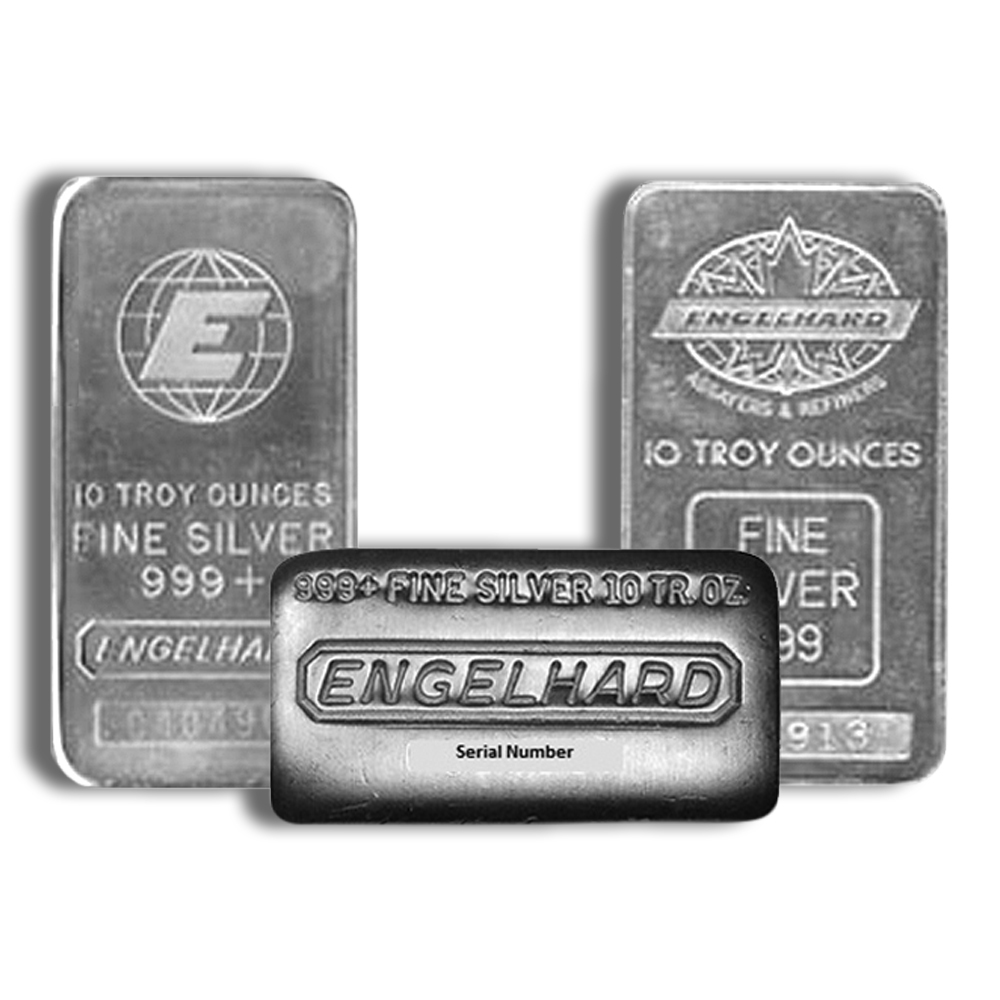
10 oz Engelhard Silver Bar — Design Varies
Design varies. The image illustrates the listing and does not guarantee a particular serial number, variety, or collector premium.
Pricing and availability can change. Review the linked product details and current order terms before purchasing.
Frequently asked questions
Are all Engelhard 10 oz silver bars collectible?
No. Engelhard branding can create collector interest, but the premium varies by variety, condition, demand, and documentation. Some examples trade primarily as bullion.
Does a serial number prove that an Engelhard bar is real?
No. A serial number is one feature to compare against known examples. It should be evaluated with weight, dimensions, markings, finish, provenance, and professional testing.
Are poured Engelhard bars worth more than pressed bars?
Not automatically. Certain poured or cast-looking varieties may attract collector interest, but value depends on the exact variety and the market at the time of sale.
Should I clean a vintage silver bar?
Usually, do not clean it before an authenticity or collector evaluation. Cleaning can change the surface and may reduce collector appeal.
Can a verifier identify the exact Engelhard variety?
Some testing instruments can help evaluate metal composition or internal consistency, but variety attribution generally also requires visual comparison, measurements, and specialist knowledge.
Conclusion
An Engelhard 10 oz silver bar should be evaluated in two stages. First, establish whether the bar is consistent with genuine 10 troy ounce silver through weight, dimensions, markings, and professional testing. Second, determine whether its exact variety, condition, and documentation justify a collector premium above ordinary bullion value. When those steps are kept separate, buyers are less likely to overpay for a vague rarity claim and sellers are better prepared to document what they actually own.
Disclosure: Silver prices, dealer bids, product availability, testing services, and collector premiums change. This article is educational and is not an appraisal, investment recommendation, authenticity guarantee, tax opinion, or promise of resale value.
Related Agate guides
- Engelhard Prospector Silver Round guide
- 10 oz Silver Bar Value guide
- Precious Metal Verifier guide
- How to Test If a Silver Round Is Real